Loading index…
2026's Resolution: Achieving a Calmer & More Organized Home

2026's Resolution: Achieving a Calmer & More Organized Home

The New Year has a way of making everything feel possible.

We imagine calmer mornings, cleaner counters, fewer reminders, and a home that just runs better. January brings that quiet optimism that this might be the year things finally feel more organized.

But for many families, those intentions start to fade by mid-month. Not because parents stop caring, but because motivation alone isn’t enough to carry a household forward.

If you want this year to feel different, the most powerful shift you can make isn’t about trying harder. It’s about building systems that don’t depend on constant effort.

One of the simplest and most effective places to start is by giving kids clear, age-appropriate responsibilities and a consistent way to follow through.
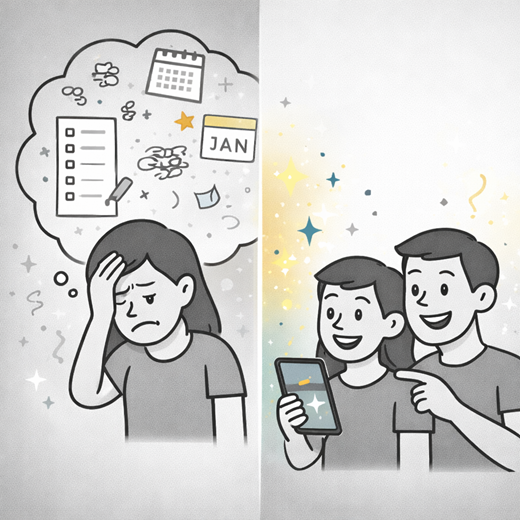

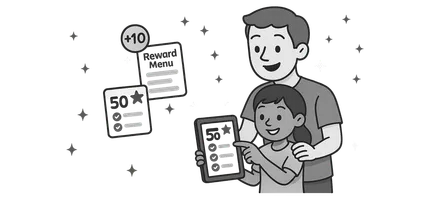
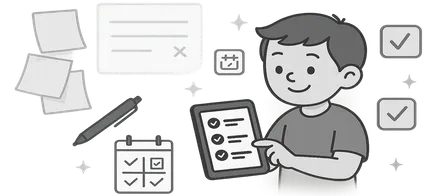
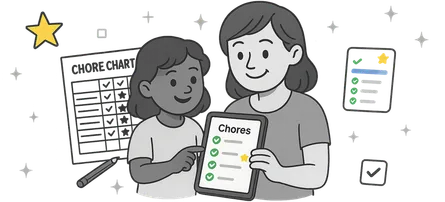
Parent and child using a digital chore app together

Why “getting organized” usually breaks down

Most New Year resolutions fail for the same reason: they live entirely in a parent’s head.

We remember what needs to happen. We track the details. We carry the mental load, and then feel frustrated when nothing sticks. Organization becomes something parents do, instead of something the family shares.

True organization doesn’t come from willpower or reminders. It comes from expectations that are visible, predictable, and understood by everyone in the house, including the kids.

When children know what they’re responsible for, when it needs to happen, and what “done” actually looks like, the dynamic changes. Responsibility becomes concrete instead of abstract, and follow-through feels more achievable for everyone.


How responsibility helps kids and parents

Giving kids responsibility isn’t about making them help more. It’s about helping them feel capable and included in how the household functions.

When kids take ownership of small, meaningful tasks, they begin to see themselves as contributors instead of passengers. Over time, that builds confidence, independence, and pride — not just compliance.

For parents, the benefits are just as real. Clear responsibility means fewer repeated instructions, fewer power struggles, and far less emotional friction. Instead of reminding, negotiating, and correcting, you’re reinforcing a system that everyone already understands.

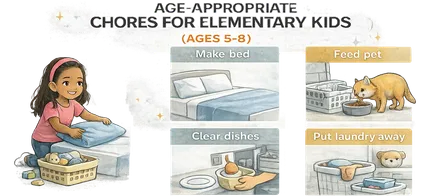
Even small routines, feeding a pet, clearing the table, packing a backpack — create momentum. And momentum is what turns intention into habit.


Where rewards fit (and where they don’t)

Rewards can be a helpful part of this process, but only when they’re used intentionally.

Effective rewards reinforce effort and consistency. They acknowledge progress without replacing responsibility itself. The goal isn’t to pay kids for every task, but to help them practice habits until those habits become internal.

Problems arise when rewards escalate too quickly, become expected, or are used to control behavior in the moment. When that happens, motivation shifts outward — and the system breaks down.

If you want a deeper look at how to use rewards without overdoing it, this guide walks through what actually works and why:
Using Rewards to Motivate Kids — What Actually Works


Parent and child using a digital chore app together

Making responsibility visible with MyChoreBoard

One of the hardest parts of building new routines is keeping expectations clear without becoming the reminder system yourself.

MyChoreBoard was designed to solve that exact problem.

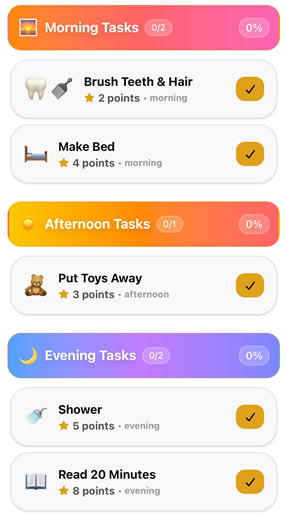
By making daily responsibilities visible, predictable, and shared, it removes the constant back-and-forth. Kids can see what needs to be done, when it needs to happen, and how their progress adds up — without waiting for a parent to prompt them.

Instead of asking, “Did you do this yet?” parents can point to the board. Kids take ownership, mark tasks complete themselves, and see how their effort connects to rewards and routines.

Over time, consistency stops feeling forced, and starts feeling normal.


Choosing rewards that actually motivate by age

What motivates a toddler isn’t what motivates a teen, and treating all kids the same is one of the fastest ways rewards lose their impact.

That’s why we break reward ideas down by age, focusing on what makes sense developmentally and emotionally at each stage. These guides emphasize small wins, earned privileges, and real-world motivation, not sticker overload.

Choosing the right rewards helps responsibility feel achievable — not overwhelming or transactional.


A better kind of New Year resolution

If you’re setting goals for the year ahead, consider this one: Build routines that don’t rely on you remembering everything.

When kids understand their role, see their progress, and know what they’re working toward, responsibility stops feeling like a daily battle. The home feels calmer. Mornings feel lighter. And organization becomes something that sustains itself.

That’s how the New Year actually starts to feel different — not just in January, but all year long.


MyChoreBoard was built to help families turn daily responsibilities into routines that last — without stress, nagging, or guesswork.

cta-image

Ready to try MyChoreBoard with your kids?

Install on any phone, tablet or computer. Free with no sign-in hoops.

Get Started Now
Related Posts

ADHD and Household Responsibilities: What Parents Should Know

ADHD and Household Responsibilities: What Parents Should Know

Why Chores Matter for ADHD Kids If asking your ADHD child to “clean your room” ends in frustration, you’re not alone. Household chores can feel like an uphill battle—but they’r

read more
Rewards That Motivate Kids (5–8): Small Wins Build Responsibility

Rewards That Motivate Kids (5–8): Small Wins Build Responsibility

If the toddler years were “Right Now, Please,” ages 5–8 are “Watch This!” Kids in this stage love to show what they can do — which makes it the perfect time to build **dail

read more
Age-Appropriate Rewards for Toddlers: Simple, Immediate & Fun

Age-Appropriate Rewards for Toddlers: Simple, Immediate & Fun

If your toddler could write their autobiography, Chapter One would be called “Right Now, Please.” At ages 2–4, kids live in the present tense — which is exactly why **simple, i

read more
Motivating Teens: Shift to Trust, Goals, & Real-World Wins

Motivating Teens: Shift to Trust, Goals, & Real-World Wins

Teens don’t want stickers — they want respect, freedom, and the aux cord.The good news? Those are exactly the kinds of rewards that help build real-world responsibility

read more
Motivating Tweens: Build Independence Without Power Struggles

Motivating Tweens: Build Independence Without Power Struggles

If ages 5–8 were “Watch this!”, the tween years (9–12) are “Let me choose.” Tweens crave a voice in how things happen — which is perfect, because voice and choice are

read more
Best Free Chore Apps in 2025: Honest Feature Comparison

Best Free Chore Apps in 2025: Honest Feature Comparison

Choosing the right chore app can make or break your family’s daily flow. Some apps promise motivation but end up turning chores into competitions. Others look simple at first—until

read more
How Chore Apps Can Help ADHD Kids Build Routines & Confidence

How Chore Apps Can Help ADHD Kids Build Routines & Confidence

When ADHD Turns Routine Into a Daily Battle Parenting a child with ADHD can feel like running a marathon that resets every morning. You start hopeful, but by lunchtime the chec

read more
Chore Apps vs Allowance Apps: What’s the Difference?

Chore Apps vs Allowance Apps: What’s the Difference?

Most parents start looking for a “chore app” when they want to stop reminding their kids 50 times a day. Others start with “allowance apps” when they want to teach money management

read more
Why Families Are Choosing Family Chore Apps

Why Families Are Choosing Family Chore Apps

Parenting in the Age of Overwhelm Parenting today feels like managing a mini start-up — school projects, sports schedules, meals, and the endless question: *“Did anyone feed th

read more
2025's Ultimate Guide to Free Chore Apps

2025's Ultimate Guide to Free Chore Apps

If you’re a parent, your brain is basically a to-do list on overdrive. Between remembering who needs pajamas for spirit day, who has soccer practice, and whether the dog’s been fed

read more
Family Rollout Plan: Getting Kids Onboard with a Chore App

Family Rollout Plan: Getting Kids Onboard with a Chore App

Getting your kids excited about a new chore app isn’t just about tech — it’s about psychology. Families succeed when they roll it out with clear expectations, fun rewards, and a sh

read more
Morning Routines for ADHD Kids That Actually Work

Morning Routines for ADHD Kids That Actually Work

Why Mornings Feel So Hard for ADHD Families If your mornings feel like a race you never signed up for, you’re in good company. Many parents describe ADHD mornings as “organized

read more
Make Rewards Feel Real: Add Photos to MyChoreBoard Rewards

Make Rewards Feel Real: Add Photos to MyChoreBoard Rewards

Kids stay motivated longer when they can see the reward they’re earning.That’s why we’re excited to introduce one of our most requested features:Add Images to Rewards

read more
Printable vs Digital Chore Charts: Which Actually Sticks in 2025?

Printable vs Digital Chore Charts: Which Actually Sticks in 2025?

Why Compare Printable vs Digital? Printable chore charts have been a parenting staple for decades, helping children visualize responsibilities and earn rewards. But as families

read more
Reward Systems That Motivate ADHD Kids (Without Bribes or Battles)

Reward Systems That Motivate ADHD Kids (Without Bribes or Battles)

Why ADHD Motivation Works Differently Parents often say, “My child can focus — just not on chores.”That’s not inconsistency; it’s neuroscience. ADHD isn’t a lack of willpo

read more
Using Sweet Treats as Rewards

Using Sweet Treats as Rewards

Sweet treats are one of the most reliably motivating rewards for kids. They are also one of the most debated. Parents often ask:Am I creating a bad habit? Will this backf

read more
How to Switch from a Whiteboard to a Free Chore App (In One Weekend)

How to Switch from a Whiteboard to a Free Chore App (In One Weekend)

If your whiteboard chore chart is covered in half-erased checkmarks and good intentions, you’re not alone. Most families outgrow paper systems once routines start to slip or multip

read more
How Positive Reinforcement Builds Motivation & Responsibility in Kids

How Positive Reinforcement Builds Motivation & Responsibility in Kids

Parents don’t need more nagging power — they need a motivation system that kids actually respond to. That’s what positive reinforcement delivers: clear expectations, inst

read more
Why Visual Cues Help ADHD Kids Stick to Routines

Why Visual Cues Help ADHD Kids Stick to Routines

Why Visuals Are a Game-Changer for ADHD Routines If you’ve ever told your ADHD child, “Go get ready,” only to find them 15 minutes later still in their pajamas building a LEGO

read more