Loading index…
Age-Appropriate Chores for Toddlers (Ages 2–4)

Age-Appropriate Chores for Toddlers (Ages 2–4)

Toddlers want to help. They just don’t want to help the way adults expect.

If you have ever handed a toddler a task and immediately regretted it, you are not alone. At ages two to four, kids are eager to participate but lack the coordination, attention span, and patience to do things “correctly.”

That does not mean chores are a bad idea at this age. It means the goal needs to be participation, not results.

This guide explains what age-appropriate chores look like for toddlers, how to introduce them without frustration, and how to lay the foundation for responsibility that grows over time.


What chores mean for toddlers

For toddlers, chores are not about productivity. They are about belonging.

Toddlers help because they want to feel included in what adults are doing. When they are invited to participate, they learn that contributing is part of everyday life, not something reserved for later.

At this age, chores should:

  • Be simple and concrete
  • Take only a few minutes
  • Have no expectation of perfection

When parents expect toddler chores to look finished or efficient, everyone gets frustrated. When the focus stays on involvement, toddlers stay engaged.


Why starting chores early actually helps later

Introducing chores during the toddler years makes future routines easier, not harder.

Kids who grow up helping in small ways often see responsibility as normal. Kids who are excluded from chores early often resist them later because they feel sudden and unfair.

Early chores help toddlers:

  • Practice following simple instructions
  • Build confidence through participation
  • Learn that everyone contributes

These early experiences shape how kids view responsibility long before chores become more complex.


Examples of age-appropriate chores for toddlers

Toddler chores should be simple actions with a clear beginning and end. Many of these tasks will still require supervision, and that is expected.

Common age-appropriate chores include:

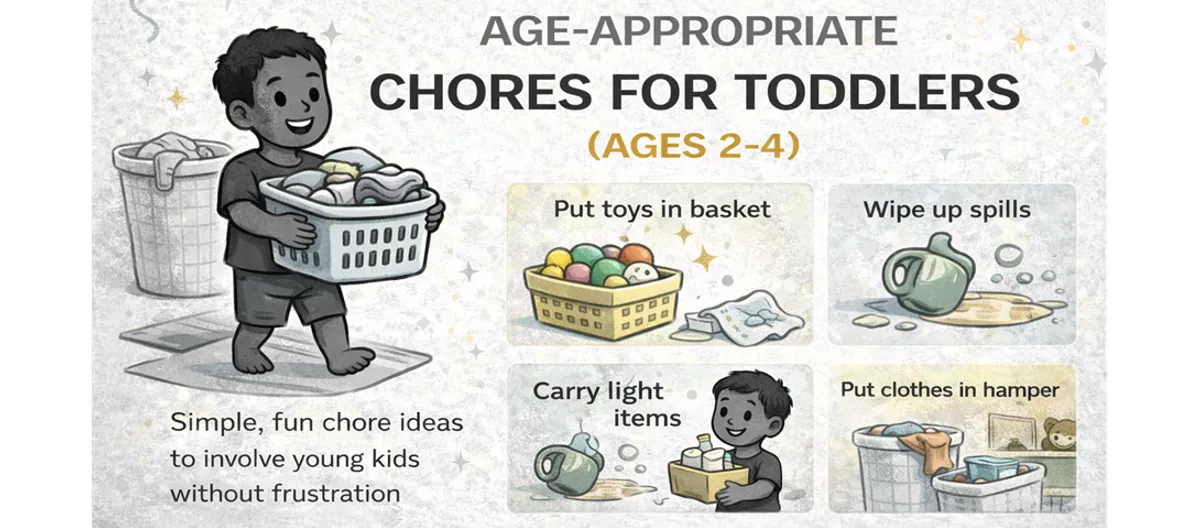
  • Putting toys into bins or baskets
  • Placing clothes into a laundry hamper
  • Wiping up small spills with a cloth
  • Carrying lightweight items
  • Helping put groceries on low shelves

The task matters less than the routine. Repeating the same small chores builds familiarity and confidence.


What to expect when toddlers help

Helping will be slow. Helping will be messy. Helping will often create more work for you.

That is normal.

Toddlers are still learning how their bodies work. They need repetition and patience, not correction. Fixing everything immediately or constantly stepping in teaches toddlers that their effort is not useful.

If safety is not an issue, let them try. The learning happens in the process.


How to introduce chores without frustration

The easiest way to introduce toddler chores is to do them together.

Narrate what you are doing, invite your child to help, and keep the task short. Avoid asking questions that invite refusal. Instead of asking, “Do you want to help clean up?” try “Let’s put the toys in the bin together.”

Praise effort rather than outcome. Simple acknowledgments like “You helped” or “Thank you for putting that away” reinforce participation without pressure.

Some families also use simple, age-appropriate rewards for toddlers to reinforce early routines, especially when chores are new or consistency is still developing.


How many chores should a toddler have?

For toddlers, fewer is better.

One or two predictable chores done daily is plenty. Repeating the same tasks helps toddlers understand expectations and reduces confusion.

Rotating chores or introducing new ones too often can feel overwhelming at this age. Consistency builds comfort.


When toddler chores go wrong

If your toddler consistently resists chores, it is usually a sign that the task is too complex, too long, or poorly timed.

Try simplifying the task, shortening the duration, or shifting it to a calmer moment of the day. Toddlers do best when chores are woven naturally into routines rather than introduced during transitions or meltdowns.


Looking ahead to the next stage

As toddlers grow into preschoolers and elementary-age kids, chores gradually shift from helping to completing tasks independently.

Starting with simple, low-pressure responsibilities now makes that transition much smoother later. The goal is not to raise a perfect helper at age three. It is to raise a child who sees responsibility as normal.

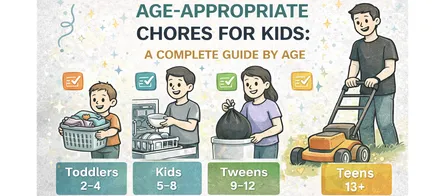
For a broader overview of how chores evolve by age, see the full guide:
Age-Appropriate Chores for Kids: A Complete Guide by Age


Frequently Asked Questions

Yes. Toddlers can participate in chores when tasks are simple and expectations are realistic. At this age, chores are about helping and learning, not completing tasks perfectly.

Many families begin introducing simple chores around age two. Starting early helps kids see responsibility as part of everyday life rather than something added later.

Rewards are not necessary for toddler chores. Praise, inclusion, and repetition are usually enough. At this age, the experience of helping is often its own motivation.

Refusal often means the task is too hard, too long, or poorly timed. Simplifying the chore and doing it together usually helps reduce resistance.

No. Messy results are expected and part of learning. If safety is not an issue, allowing toddlers to try builds confidence and familiarity with responsibility.

cta-image

Ready to try MyChoreBoard with your kids?

Install on any phone, tablet or computer. Free with no sign-in hoops.

Get Started Now
Related Posts

2026's Resolution: Achieving a Calmer & More Organized Home

2026's Resolution: Achieving a Calmer & More Organized Home

The New Year has a way of making everything feel possible. We imagine calmer mornings, cleaner counters, fewer reminders, and a home that just runs better. January brings that qui

read more
Age-Appropriate Chores for Elementary Kids (Ages 5–8)

Age-Appropriate Chores for Elementary Kids (Ages 5–8)

Elementary-age kids are capable of far more than many parents expect, but they still need structure to succeed. Between the ages of five and eight, children move from simply h

read more
ADHD and Household Responsibilities: What Parents Should Know

ADHD and Household Responsibilities: What Parents Should Know

Why Chores Matter for ADHD Kids If asking your ADHD child to “clean your room” ends in frustration, you’re not alone. Household chores can feel like an uphill battle—but they’r

read more
Age-Appropriate Chores for Teens (Ages 13+)

Age-Appropriate Chores for Teens (Ages 13+)

Teenagers are closer to adulthood than childhood, and their chores should reflect that. By the teen years, kids are capable of managing complex responsibilities, making decisi

read more
Age-Appropriate Chores for Kids: A Complete Guide by Age

Age-Appropriate Chores for Kids: A Complete Guide by Age

One of the most common questions parents ask is simple, but surprisingly difficult to answer: What chores should my child actually be doing at this age? Chores are one of th

read more
Age-Appropriate Chores for Tweens (Ages 9–12)

Age-Appropriate Chores for Tweens (Ages 9–12)

Tweens are capable, opinionated, and increasingly aware of what feels fair. Between the ages of nine and twelve, kids are no longer just following routines. They are beginning

read more
Rewards That Motivate Kids (5–8): Small Wins Build Responsibility

Rewards That Motivate Kids (5–8): Small Wins Build Responsibility

If the toddler years were “Right Now, Please,” ages 5–8 are “Watch This!” Kids in this stage love to show what they can do — which makes it the perfect time to build **dail

read more
Motivating Teens: Shift to Trust, Goals, & Real-World Wins

Motivating Teens: Shift to Trust, Goals, & Real-World Wins

Teens don’t want stickers — they want respect, freedom, and the aux cord.The good news? Those are exactly the kinds of rewards that help build real-world responsibility

read more
Best Free Chore Apps in 2025: Honest Feature Comparison

Best Free Chore Apps in 2025: Honest Feature Comparison

Choosing the right chore app can make or break your family’s daily flow. Some apps promise motivation but end up turning chores into competitions. Others look simple at first—until

read more
Motivating Tweens: Build Independence Without Power Struggles

Motivating Tweens: Build Independence Without Power Struggles

If ages 5–8 were “Watch this!”, the tween years (9–12) are “Let me choose.” Tweens crave a voice in how things happen — which is perfect, because voice and choice are

read more
How Chore Apps Can Help ADHD Kids Build Routines & Confidence

How Chore Apps Can Help ADHD Kids Build Routines & Confidence

When ADHD Turns Routine Into a Daily Battle Parenting a child with ADHD can feel like running a marathon that resets every morning. You start hopeful, but by lunchtime the chec

read more
Chore Apps vs Allowance Apps: What’s the Difference?

Chore Apps vs Allowance Apps: What’s the Difference?

Most parents start looking for a “chore app” when they want to stop micromanaging daily routines and build consistency at home. Other parents start with “allowance apps” when they

read more
Clothing Rewards: Extras Become Powerful Motivation

Clothing Rewards: Extras Become Powerful Motivation

**Clothing might not be the first thing parents think of when they hear “rewards,” but for many kids, non-essential clothing can be one of the most motivating options available—esp

read more
Why Families Are Choosing Family Chore Apps

Why Families Are Choosing Family Chore Apps

Parenting in the Age of Overwhelm Parenting today feels like managing a mini start-up — school projects, sports schedules, meals, and the endless question: *“Did anyone feed th

read more
Family Rollout Plan: Getting Kids Onboard with a Chore App

Family Rollout Plan: Getting Kids Onboard with a Chore App

Getting your kids excited about a new chore app isn’t just about tech — it’s about psychology. Families succeed when they roll it out with clear expectations, fun rewards, and a sh

read more
2025's Ultimate Guide to Free Chore Apps

2025's Ultimate Guide to Free Chore Apps

If you’re a parent, your brain is basically a to-do list on overdrive. Between remembering who needs pajamas for spirit day, who has soccer practice, and whether the dog’s been fed

read more
Age-Appropriate Rewards for Toddlers: Simple, Immediate & Fun

Age-Appropriate Rewards for Toddlers: Simple, Immediate & Fun

If your toddler could write their autobiography, Chapter One would be called “Right Now, Please.” At ages 2–4, kids live in the present tense — which is exactly why **simple, i

read more
Morning Routines for ADHD Kids That Actually Work

Morning Routines for ADHD Kids That Actually Work

Why Mornings Feel So Hard for ADHD Families If your mornings feel like a race you never signed up for, you’re in good company. Many parents describe ADHD mornings as “organized

read more
Make Rewards Feel Real: Add Photos to MyChoreBoard Rewards

Make Rewards Feel Real: Add Photos to MyChoreBoard Rewards

Kids stay motivated longer when they can see the reward they’re earning.That’s why we’re excited to introduce one of our most requested features:Add Images to Rewards

read more
Non-Toy Rewards Kids Actually Want

Non-Toy Rewards Kids Actually Want

**Looking for effective rewards that don’t add more toys to your house? This guide explains how non-toy rewards motivate kids, support routines, and work naturally inside a points-

read more
Printable vs Digital Chore Charts: Which Actually Sticks in 2025?

Printable vs Digital Chore Charts: Which Actually Sticks in 2025?

Why Compare Printable vs Digital? Printable chore charts have been a parenting staple for decades, helping children visualize responsibilities and earn rewards. But as families

read more
Reward Systems That Motivate ADHD Kids (Without Bribes or Battles)

Reward Systems That Motivate ADHD Kids (Without Bribes or Battles)

Why ADHD Motivation Works Differently Parents often say, “My child can focus — just not on chores.”That’s not inconsistency; it’s neuroscience. ADHD isn’t a lack of willpo

read more
Using Sweet Treats as Rewards

Using Sweet Treats as Rewards

Sweet treats are one of the most reliably motivating rewards for kids. They are also one of the most debated. Parents often ask:Am I creating a bad habit? Will this backf

read more
Why Visual Cues Help ADHD Kids Stick to Routines

Why Visual Cues Help ADHD Kids Stick to Routines

Why Visuals Are a Game-Changer for ADHD Routines If you’ve ever told your ADHD child, “Go get ready,” only to find them 15 minutes later still in their pajamas building a LEGO

read more
How to Switch from a Whiteboard to a Free Chore App (In One Weekend)

How to Switch from a Whiteboard to a Free Chore App (In One Weekend)

If your whiteboard chore chart is covered in half-erased checkmarks and good intentions, you’re not alone. Most families outgrow paper systems once routines start to slip or multip

read more
How Positive Reinforcement Builds Motivation & Responsibility in Kids

How Positive Reinforcement Builds Motivation & Responsibility in Kids

Parents don’t need more nagging power — they need a motivation system that kids actually respond to. That’s what positive reinforcement delivers: clear expectations, inst

read more