Best Chore Charts for Kids in 2026: Printable, Magnetic, Velcro, Fridge, and Digital Options
- Jacob Volk
- Chores & Routines
- 31 Jul, 2026
The best chore chart for kids is not one product. It is the format that matches your child’s age and the amount of maintenance your family can realistically keep up with.
For some families, the best answer is a free sheet of paper. For a preschooler, it may be a picture-based magnetic or Velcro board. For several kids with different schedules, a digital system can save much more parent time.
This comparison is designed to help you choose the format before you buy anything.
| Best for | Our pick | Why we chose it |
|---|---|---|
| Trying a chore chart for the first time | Free MyChoreBoard printable pack | No purchase required, four layouts, and easy to change as you learn what works |
| Younger kids who want a ready-made magnetic chart | Melissa & Doug Mickey Mouse My Magnetic Responsibility Chart | A tactile, structured system with 90 responsibility, behavior, and reward magnets |
| Kids motivated by earning visible rewards | Inamio Magnetic Kids Responsibility Reward Chart | 80+ chore choices plus 300 physical stars make the reward loop highly visible |
| Non-readers and picture-based routines | ALSLEA Visual Schedule for Kids | Picture cards show what happens next instead of relying on a written weekly grid |
| Multiple kids and household-specific chores | Oyster&Pop 3-Piece Magnetic Chore Chart Set | Three separate reusable boards give each child room for completely custom tasks |
| Different recurring schedules / lowest parent maintenance | Digital chore chart | Separate assignments, recurring tasks, and automatic points/reward tracking |
How we evaluated the options
These recommendations are based on current product research and the practical differences between chore-chart formats.
We did not try to find four versions of the same magnetic board. Instead, we chose products that solve different problems a family might actually have: a ready-made chart for a younger child, a stronger physical reward system, a picture-based visual schedule, and a flexible setup for multiple children.
We compared:
- Child age and reading ability
- How clearly a child can see what to do next
- Number and type of included chores or visual cards
- Custom chore options
- Daily and weekly flexibility
- Multi-child use
- Reward tracking
- Storage and management of pieces
- Mounting/display method
- How the format gives the child feedback or a sense of progress
How each chore-chart format engages kids
Maintenance matters, but it is only half of the decision. The child also has to keep noticing and using the chart. Different formats create different kinds of engagement.
| Format | How it can engage the child |
|---|---|
| Magnetic responsibility chart | Moving magnets and physically seeing responsibilities change |
| Magnetic reward chart | Earning and collecting visible stars or tokens |
| Velcro picture schedule | Moving or removing picture cards as the child progresses through a routine |
| Dry-erase / printable chart | Making checkmarks, using stickers, coloring, or seeing a visible paper record of completion |
| Digital chore chart | Interactive completion feedback, changing point totals, visual rewards, optional Bonus Tasks, and animations or celebrations |
There is no universal winner here. A child who loves stickers may be more engaged by paper than an app. Another child may stop noticing a refrigerator chart but keep returning to a digital list that reacts immediately when they make progress.
- Parent setup and reset effort
- How well the system can adapt when routines change
We intentionally do not use fake star ratings or call something “best” simply because it has a high retailer review score. Each recommendation below is tied to a specific use case.
Best free printable chore chart: MyChoreBoard 4-page pack
Best for: families who want to test a chore chart before buying a system.
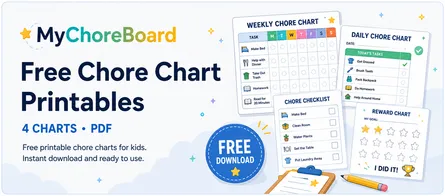
The printable pack includes daily, weekly, points/rewards, and multi-child layouts in both US Letter and A4.
A printable is the best first test because it tells you whether the problem is the routine or the format. If your child ignores a simple three-task paper chart, buying a more elaborate magnetic board may not fix the underlying issue. On the other hand, if the paper chart works but you get tired of rewriting it, you have learned exactly what you want from the next system.
Why we chose it: it costs nothing, takes only a few minutes to try, and gives you a baseline before spending money on a physical chart.
What to know: printables require manual resetting and do not automatically total points or remember recurring schedules.
Get it here: Free Printable Chore Charts for Kids.
Best ready-made magnetic chart for younger kids: Melissa & Doug Mickey Mouse My Magnetic Responsibility Chart
Best for: preschool and early-elementary kids who like a tactile chart and do better when most of the setup is already done for them.
This is the most traditional chore-chart choice in our group. The Melissa & Doug Mickey Mouse My Magnetic Responsibility Chart is a wood-framed, double-sided magnetic board. One side is used to track responsibilities and behavior, while the other is a magnetic dry-erase surface that can hold the pieces. Melissa & Doug says it includes 90 responsibility, behavior, and reward magnets, plus a blank magnet for personalization, and recommends it for ages 3 and up.
Why we chose it
The advantage here is low setup effort for the parent. You do not need to design icons, print cards, laminate anything, or invent a tracking system. A younger child can pick from recognizable magnetic pieces and physically place rewards as goals are completed.
It is also useful that responsibilities and rewards live in the same system. For a child who enjoys choosing a magnet and seeing it move onto the board, that tactile interaction may be more engaging than checking a box on paper.
The Mickey Mouse theme is part of the tradeoff. It can make the chart more appealing to a young Disney fan, but it also means this is not the physical chart we would choose for an older child who wants something more neutral.
What we like: ready-made magnetic pieces, very little parent design work, reward magnets included, durable double-sided board.
What to know: the included vocabulary will not match every family’s chores, the Disney design skews younger, and small magnetic pieces still need to be kept organized. The manufacturer lists a small-parts warning and recommends ages 3+.
Affiliate Disclosure: As an Amazon Associate, we earn from qualifying purchases. These are researched recommendations, and prices/availability can change.
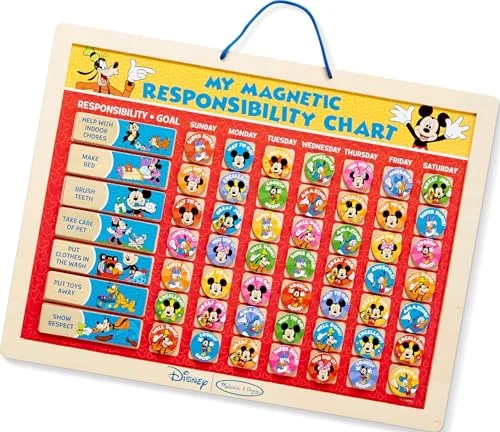
Melissa & Doug Disney Chore Chart
Toddler Routine, Kids Reward Board, Reward Chart for Toddlers and Kids Ages 3+
Best for visible physical rewards: Inamio Magnetic Kids Responsibility Reward Chart
Best for: kids who are especially motivated by earning something they can physically see accumulate.
The Inamio chart is not just a checklist with magnets. Its strongest feature is the reward loop. Inamio says the 12 x 17-inch magnetic board comes with 80+ preprinted chore tiles and 300 stars, along with blank tiles, four colored markers, and a storage pouch. It can be mounted on a refrigerator or hung on a wall, and the manufacturer targets roughly ages 3-9.
Why we chose it
If your child likes the idea of “earning stars,” this system makes that progress extremely concrete. The child is not merely checking off a task; the stars become a visible record of what has been accomplished. That can make the connection between chores and rewards easier to understand for a younger child.
It is also more customizable than many preprinted magnetic boards. The large set of included chores gives you a useful starting point, while the blank pieces and markers give you somewhere to put household-specific jobs that the manufacturer could never predict.
Among the physical charts here, this is the closest match to a simple chore → points/stars → reward system. The downside is that the parent still has to manage that economy manually: deciding how many stars a task earns, what rewards cost, and when the chart resets.
What we like: lots of included chore choices, a large supply of physical stars, customizable blanks, fridge or wall mounting, and a storage pouch for the pieces.
What to know: there are many pieces to manage, the look is aimed at younger children, and the reward math remains a parent-managed system rather than something the chart calculates for you.
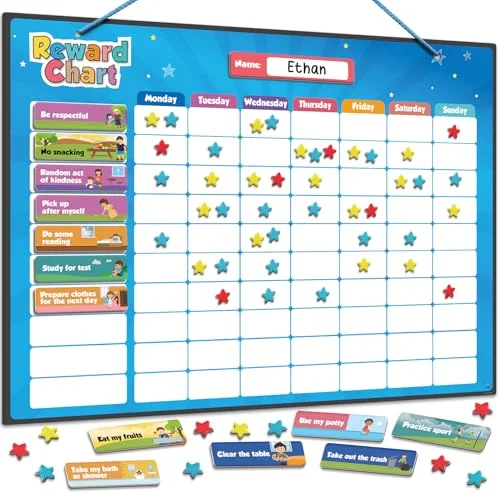
inamio Magnetic Kids Chore Chart
Boost your child's motivation with an interactive responsibility chart, featuring tactile 3D stars and 80+ diverse chores from potty training to household tasks. Engage, reward, and celebrate their accomplishments!
Best picture-based routine for non-readers: ALSLEA Visual Schedule for Kids
Best for: preschoolers, non-readers, and children who understand a sequence of pictures more easily than a weekly grid.
The ALSLEA Visual Schedule is intentionally different from the other products in this list. It is less of a traditional Monday-through-Sunday chore chart and more of a visual routine board. The felt board uses removable illustrated activity cards so a child can see the order of a routine: get dressed, eat breakfast, brush teeth, pack a backpack, and so on.
Current versions of the product are sold with a large set of visual cards, including activity cards, title cards, blank cards, arrows, and reward stars. The board can be hung vertically or horizontally, and the cards can be rearranged when the routine changes.
Why we chose it
For a child who cannot comfortably read “Brush Teeth” or scan a seven-column weekly chart, an illustration of a toothbrush can communicate the task immediately. Just as important, the left-to-right or top-to-bottom sequence answers a different question than a normal chore chart: “What do I do next?”
That makes this a strong format for morning, after-school, and bedtime routines. A standard magnetic chart may be better when the goal is tracking whether a chore happened each day; the ALSLEA-style visual schedule is better when the challenge is getting through a sequence in order.
We are recommending it here because it represents that format well, not because we are making a clinical claim about visual schedules or any diagnosis. Families may find picture sequencing useful for many different reasons.
What we like: does not depend on reading, makes sequence obvious, lots of included visual choices, and can be rearranged as routines change.
What to know: it is more of a routine/schedule tool than a traditional weekly chore grid, it takes more wall space than a small fridge chart, and reward tracking is secondary rather than the main feature.
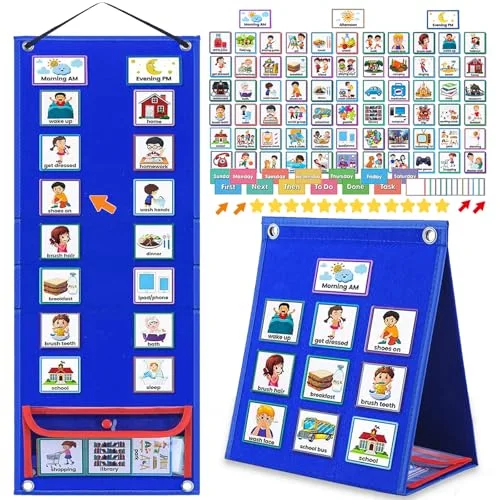
Velcro Visual Scheduler for Kids
ALSLEA's visual schedule board is made of flannel with nylon backing for durability and will not tear or wrinkle easily. The visual schedule can be used to arrange the morning and evening routine of young children and cultivate their sense of time.
Best magnetic chore chart for multiple kids: Oyster&Pop 3-Piece Magnetic Chore Chart Set
Best for: families with two or three kids who want separate physical charts and chores that are completely customizable.
Oyster&Pop takes almost the opposite approach from a board full of preprinted chore magnets. The set gives you three separate magnetic dry-erase chore charts, each about 10 x 8 inches, so each family member can have an individual list on the refrigerator. The boards are reusable and designed to be written on with fine-tip dry-erase markers.
Why we chose it
The biggest advantage is that there is no fixed chore vocabulary. A preprinted system works well until your actual task is “Pack swim bag,” “Put recycling by garage door,” or “Bring library book downstairs.” With a writable board, the chore can be exactly what your family calls it.
The three-board setup also solves a common physical-chart problem: once several children share one board, the chart can become crowded and hard to scan. Giving each child a separate board keeps ownership obvious while still putting the whole system in one shared place such as the refrigerator.
This is the physical option we like most for families whose chores change frequently but whose schedules are still simple enough that a parent does not mind rewriting the boards. If you start copying the same recurring schedules onto three boards every week, that is the point where a digital system begins to save meaningful time.
What we like: three separate boards, totally custom task wording, reusable dry-erase surface, compact refrigerator-friendly size, and a format that can grow beyond “kid chores” into reminders or family task lists.
What to know: the parent still has to write and reset the tasks, there are no built-in picture cues for non-readers, and rewards/points have to be tracked separately unless you build them into the written chart.
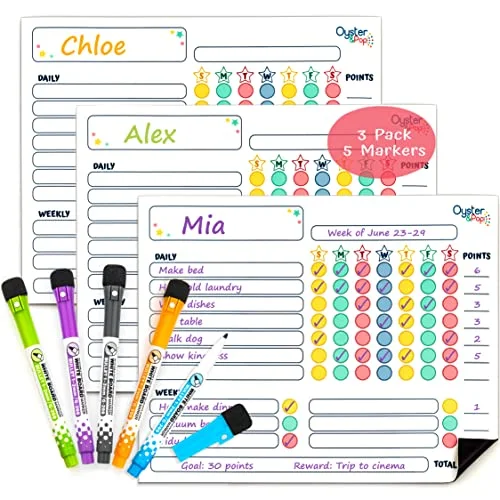
Magnetic Dry Erase Chore Chart
Build positive behavior, responsibility and routines - give every child their own magnetic chart and weekly rewards.
Physical vs. digital for multiple kids
The Oyster&Pop set is our physical pick when you have multiple children and the schedule is still simple. Each child gets a separate board, everyone can see the charts in one shared place, and you can write chores exactly the way your family describes them.
The tradeoff is parent maintenance. Three boards also means three boards to rewrite, reset, and keep current.
Once children have different recurring schedules, separate point balances, rewards, optional chores, or chores that change by day, a digital chore chart becomes much easier to maintain. MyChoreBoard keeps each child’s assignments separate and can repeat schedules automatically instead of asking a parent to rebuild the same chart every week.
Best digital chore chart: MyChoreBoard
Best for: families that want a focused chore-and-reward system without buying an expensive dedicated wall calendar.
MyChoreBoard is our own product, so this recommendation is not independent. It is included because it is the digital system this site is built around.
It supports:
- Multiple child profiles
- Recurring chore schedules
- Points and custom rewards
- Reward images
- Bonus Tasks
- Shared Task Pool chores
- Big Icons Mode
- Focus Mode
- WallBoard Mode for a shared family tablet
- Web, iPhone/iPad, Android, and Amazon Fire access
It does not need to replace every family calendar or planning tool. Its strength is staying focused on chores, routines, points, and rewards.
The digital advantage is also not limited to parent maintenance. The chart can respond to the child. Completing a task can immediately change the screen, update points, move a desired reward closer, and provide fun visual feedback. Bonus Tasks can give kids optional ways to earn more, and completion animations or celebrations can make finishing the routine feel like an accomplishment rather than simply removing another item from a list.
That will not motivate every child more than a sticker, magnet, or Velcro card. But for kids who enjoy interactive feedback, a digital chart can be substantially more engaging than a static checklist.
Best low-maintenance option
If your definition of “best” means the least weekly rewriting, digital wins.
A printable requires resetting. A magnetic chart requires moving pieces back. A whiteboard requires rewriting rows. A digital recurring schedule can keep producing the correct chores without rebuilding the board.
That does not make digital better for every child. It makes it better for the parent-maintenance problem—and, for children who respond to interactive feedback, it can also make the routine more engaging to check and complete.
How to choose by age
Ages 3-5
Prioritize pictures, a short task list, and tactile interaction. Use manufacturer age guidance for charts with small magnets.
Ages 6-9
Kids can usually handle a simple weekly chart, points, and more household responsibilities. Magnetic, printable, dry-erase, and digital can all work.
Ages 10+
Customization and independence matter more than cute graphics. A clean whiteboard or digital system may feel more age-appropriate.
How to choose by family size
One child: almost any chart can stay simple.
Two children: physical systems still work well if each child has a clear section or color.
Three or more children: make sure the chart has enough visual space. If the board becomes a scheduling spreadsheet, digital is usually easier.
How to choose by parent maintenance
Ask yourself what you are willing to do every Sunday night.
If resetting stickers and rewriting chores feels satisfying, a physical board is fine. If it already feels like a burden before you begin, choose a format that remembers more of the schedule.
When a physical chart is better than MyChoreBoard
A physical chart is better when:
- The child needs a tactile object.
- The routine is very simple.
- You want the system to stay completely off screens.
- A single location works for everyone.
- Automatic tracking is not important.
We do not recommend replacing a system that already works just because MyChoreBoard exists.
When MyChoreBoard is better than a physical chart
It becomes more useful when the parent is manually solving the same scheduling and tracking problems over and over:
- Different chores on different days
- Multiple children
- Reward balances
- Optional extra jobs
- Shared chores
- Frequent routine changes
- A desire to use phones plus a shared tablet
For the full digital comparison, see Digital Chore Charts for Kids. For detailed physical options, see Refrigerator, Magnetic, and Velcro Chore Charts.
Frequently asked questions
A picture-based magnetic or Velcro chart is often a strong fit because the child can recognize tasks without relying on reading. Keep the list short and use large, simple visuals.
You do not necessarily need new chores. First refresh the system: simplify the list, move the chart, change the rewards, or let your child help choose how progress is marked. If the chart still feels invisible, changing formats can help. Younger kids may respond to new magnets, stickers, or picture cards, while some older kids are more interested in a digital system where completing chores changes their points, rewards, and on-screen progress immediately.
For a simple family schedule, we like separate reusable boards such as the Oyster&Pop 3-piece magnetic set because each child gets a clear space and the chores can be customized. For different recurring schedules and separate point/reward balances, a digital chore chart is usually easier to maintain.
Only if the format solves a real problem for your family. A free printable can teach you what works before you spend money. Pay for a physical product when the tactile pieces or durable reusable format will actually improve use.

Ready to try MyChoreBoard with your kids?
Install on any phone, tablet or computer. Free with no sign-in hoops.