Refrigerator, Magnetic, and Velcro Chore Charts: Which One Works Best for Kids?
- Jacob Volk
- Chores & Routines
- 06 Aug, 2026
A physical chore chart has one advantage no app can completely replace: it is right there in the room.
A child can move a magnet, attach a Velcro picture card, erase a box, or place a star. That tactile interaction can be especially useful for younger kids and families that want responsibilities visible without opening a device.
But “physical chore chart” covers several very different systems. A magnetic responsibility chart, a Velcro visual schedule, and a dry-erase refrigerator board may all live in the same kitchen, but they solve different problems.
The easiest way to choose one is to start with how you want the chart to work, not with a specific brand.
This guide compares the main physical formats:
- Magnetic responsibility and reward charts for tactile tracking and visible rewards
- Velcro picture schedules for non-readers and step-by-step routines
- Dry-erase refrigerator charts for completely custom chores
- DIY printable or Velcro systems for families that want maximum flexibility
We also include a few specific products as examples of each format, but the goal is to help you choose the type of system that fits your child and routine.
What matters most
Think about reading ability, whether your child likes moving physical pieces, how often chores change, whether rewards are part of the system, how many children need a chart, and how much resetting you want to do each week.
Quick comparison: physical chore chart types
| Chart type | Best for | Biggest advantage | Parent upkeep | Main limitation |
|---|---|---|---|---|
| Magnetic responsibility / reward chart | Younger kids, tactile learners, visible rewards | Kids can physically move pieces or earn stars | Medium | Preprinted pieces may not match every household; pieces need storage |
| Velcro picture schedule | Non-readers and step-by-step routines | Makes “what comes next?” easy to see | Low-medium | Better for routine sequencing than weekly chore or point tracking |
| Dry-erase fridge chart | Custom chores and multiple kids | Write exactly what your family needs | Medium-high | Someone must rewrite and reset the board |
| DIY printable / Velcro chart | Budget-conscious or highly custom setups | Maximum flexibility | Depends on design | More parent setup; may be less durable |
| Digital chore chart | Complex recurring schedules, points, and rewards | Automates repeated setup and tracking | Low after setup | Requires a device |
Magnetic chore charts: best when kids like moving pieces and earning something visible
Magnetic chore charts are probably what most parents picture when they think of a refrigerator chore chart. The board stays in one obvious place, and the child interacts with physical pieces instead of simply reading a list.
The biggest advantage is tactile feedback. A child can move a magnet, place a star, or mark a responsibility as complete. For some kids, that physical action makes progress feel more concrete than a written checklist.
Magnetic systems also tend to require relatively little setup when they come with preprinted chores and rewards. That can be especially helpful for younger children who are still learning what the routine looks like.
Different styles of magnetic chore charts
Not every magnetic chart works the same way.
Preprinted responsibility charts come with common chores, behaviors, and reward magnets. They are easy to start using because the parent does not have to create the pieces.
Reward-focused magnetic charts put more emphasis on stars, tokens, or other visible markers. These can work well when the child is motivated by watching something accumulate.
Themed magnetic charts use characters, colors, or playful illustrations to make the board more appealing to younger children.
The tradeoff is that preprinted magnets can never match every household. If your child’s routine includes something specific like “pack swim bag” or “feed the gecko,” you may need blank pieces or a different format.
Magnetic chore chart examples
These are examples of the different magnetic styles described above rather than a ranking of one product against another.
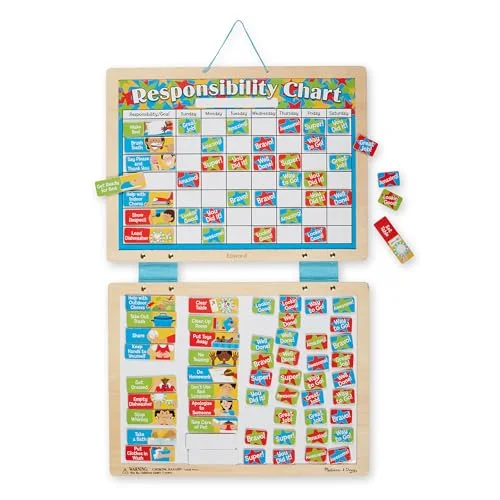
Melissa & Doug Magnetic Responsibility Chart
Behavior Tracking Made Easy This wooden magnetic responsibility chart includes two hinged dry-erase boards and 89 magnets to help track goals, chores, and positive behaviors in an interactive and visual way.
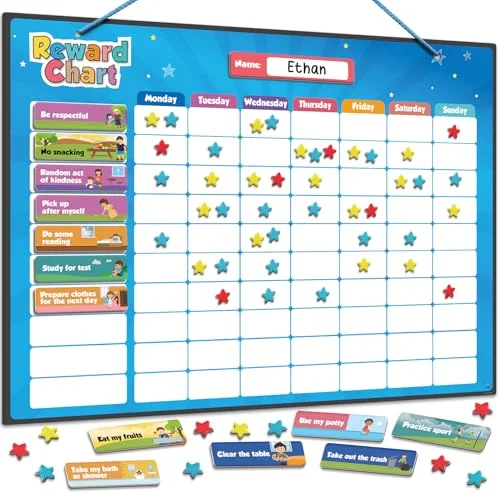
inamio Magnetic Kids Chore Chart
Boost your child's motivation with an interactive responsibility chart, featuring tactile 3D stars and 80+ diverse chores from potty training to household tasks. Engage, reward, and celebrate their accomplishments!
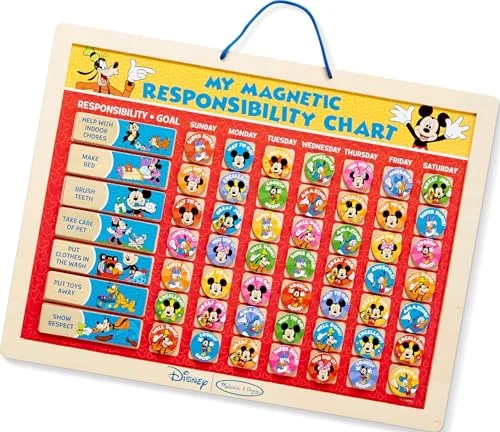
Melissa & Doug Disney Chore Chart
Toddler Routine, Kids Reward Board, Reward Chart for Toddlers and Kids Ages 3+
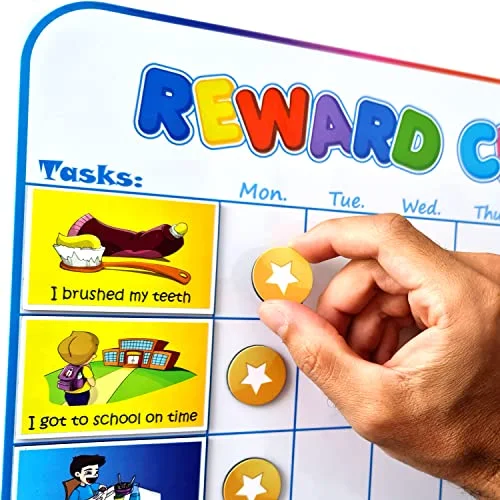
Large Magnetic Reward Chart for Kids
FUN & EASY TO USE MAGNETIC REWARD CHART (FOR FRIDGE): HMmagnets reward chart is thicker, sturdier, and larger (13.5"X16"), fitting most fridges. Use for 7 weekly chores or 21 daily achievements.
Affiliate Disclosure: As an Amazon Associate, we earn from qualifying purchases.
Velcro and felt chore charts: best when pictures and sequence matter more than a weekly grid
Velcro-style charts and felt visual schedules solve a somewhat different problem.
Instead of asking a child to look across Monday, Tuesday, Wednesday, and Thursday, a visual schedule can simply show:
Get dressed → Eat breakfast → Brush teeth → Pack backpack
For a non-reader or a child who has trouble remembering a multi-step routine, that can be much easier to understand.
Why Velcro and felt systems work differently
The strongest feature is usually not point tracking. It is answering:
“What do I do next?”
Picture cards let a child recognize the task without needing to read it. Because the pieces can be moved, removed, or placed into a completed area, the child also gets the same kind of tactile feedback that makes magnetic systems appealing.
There are a few common variations.
Sequential visual schedules arrange picture cards in the order a routine happens. These are particularly useful for morning, after-school, and bedtime routines.
Felt incentive or responsibility charts can combine removable pieces with a more traditional “do the job, then mark it complete” structure.
Custom Velcro systems can be especially flexible because parents can print or make picture cards for very specific household routines.
The main limitation is that a visual sequence is not automatically a good weekly tracking system. If you need Monday-through-Sunday completion, detailed point totals, or several children on one board, another format may work better.
Velcro and felt chore chart examples
These show two different ways removable picture or felt-based pieces can be used for routines and responsibilities.
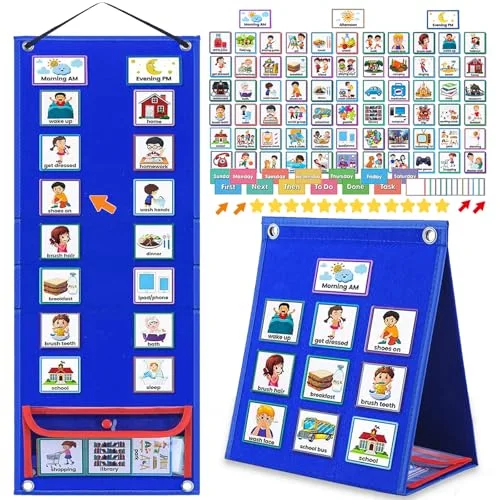
Velcro Visual Scheduler for Kids
ALSLEA's visual schedule board is made of flannel with nylon backing for durability and will not tear or wrinkle easily. The visual schedule can be used to arrange the morning and evening routine of young children and cultivate their sense of time.
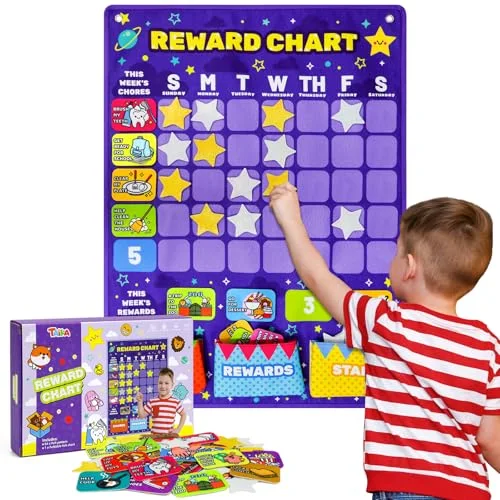
Felt Incentive Chart
This incentive reward chart designed with three pockets help with organization and management. The chore chart has two hanging loop so you can hang it at anywhere
Affiliate Disclosure: As an Amazon Associate, we earn from qualifying purchases.
Dry-erase refrigerator chore charts: best when your chores are too specific for preprinted pieces
The biggest weakness of a preprinted magnetic chore chart is that the manufacturer has to guess what chores your family does.
“Make bed” is easy.
“Pack swim bag,” “Put recycling by the garage door,” “Bring library book downstairs,” and “Feed the gecko” are not.
That is where a writable refrigerator chart becomes much more useful.
Why families choose dry-erase charts
The biggest advantage is complete control over the wording.
You can write exactly what needs to happen and change it whenever the routine changes. There is no need to hunt through a pile of magnets for a task that may not exist.
Dry-erase systems also come in several forms.
Traditional weekly boards give you rows for chores and columns for days. These are useful when you want to see the entire week at once.
Slider-style checklists combine writable chores with a physical slider or switch the child moves when a task is complete. That adds some tactile interaction without requiring a box full of loose magnets.
Acrylic magnetic boards provide a cleaner reusable writing surface while still attaching directly to a refrigerator or other magnetic surface.
For multiple children, separate writable boards can also be easier to scan than one giant shared grid.
The tradeoff is straightforward: the flexibility comes from parent labor. Someone still has to write the chores, erase the old schedule, and reset the board.
Dry-erase and refrigerator chore chart examples
These examples show the range from a traditional writable board to a slider checklist and an acrylic magnetic design.
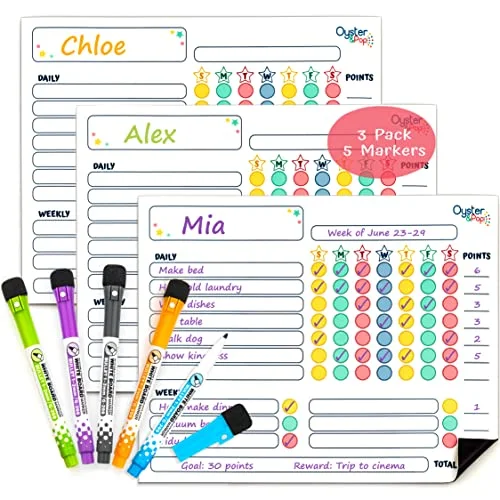
Magnetic Dry Erase Chore Chart
Build positive behavior, responsibility and routines - give every child their own magnetic chart and weekly rewards.
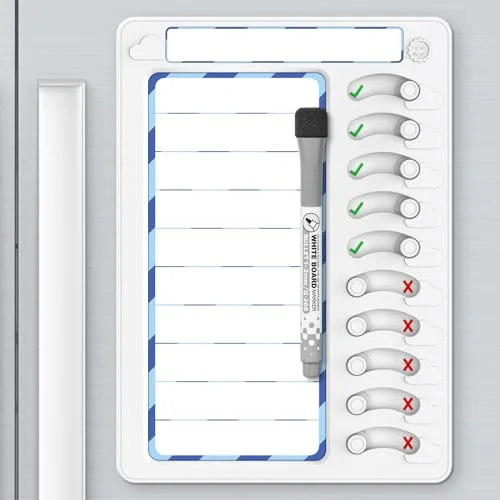
Dry Erase Chore With Slider
This KAQUBE dry erase chore board task chart for kids is designed to help children develop positive behavior habits, such as doing chores, establishing morning and bedtime routines, practicing good manners, and more. It's a fun and effective way to encourage your child's growth.
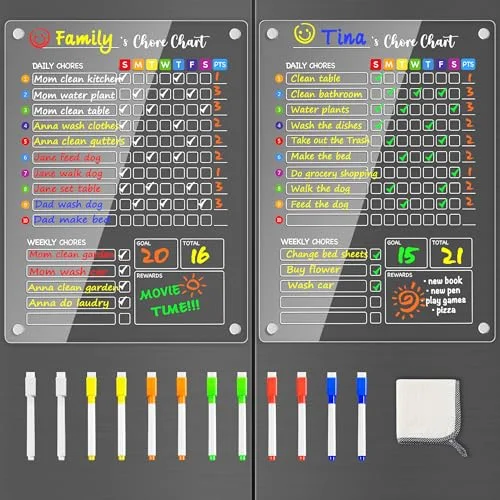
Acrylic Magnetic Chore Chart
Fun & Motivating Point System: Makes family chores fun! Set goals, track progress, earn points, and reward efforts to encourage responsibility and engagement.
Affiliate Disclosure: As an Amazon Associate, we earn from qualifying purchases.
Which physical chore chart is best for one child?
For one child, the best format depends less on household size and more on how the child understands and responds to the chart.
Choose a magnetic responsibility chart if the child likes moving pieces and benefits from seeing completed chores or earned stars.
Choose a Velcro picture schedule if reading is not yet the right interface or the biggest challenge is following a routine in order.
Choose a dry-erase fridge chart if your chores are unusually specific or change often and you want to write them exactly as your family uses them.
For a very simple routine, a DIY printable can work just as well as a purchased system.
Which physical chore chart is best for multiple kids?
With multiple children, the biggest issue is usually clarity.
A single board can get crowded once you combine:
- Child names
- Different chores
- Different days
- Different point values
- Different colors
- Different completion marks
For simple schedules, separate dry-erase boards can work very well because each child gets a clearly defined space.
Magnetic systems can also work if each child has their own board or set of rows, but the number of pieces can grow quickly.
Velcro visual schedules are usually strongest when each child has an individual routine rather than when several children share one large chart.
If each child has a different recurring schedule and the parent is repeatedly rebuilding several physical charts, that is often the point where a digital chore chart starts to save meaningful time.
What about making your own Velcro or magnetic chore chart?
A DIY physical chart can work extremely well, especially if you already know exactly how you want the system to behave.
A simple setup can be:
- Print a blank chart or draw a grid.
- Laminate it or place it in a page protector.
- Add magnetic backing if it will live on the refrigerator.
- Print picture cards for non-readers.
- Attach hook-and-loop dots if you want a Velcro-style system.
- Add a pocket or envelope for unused pieces.
- Use stars, stickers, magnets, or dry-erase marks to show completion.
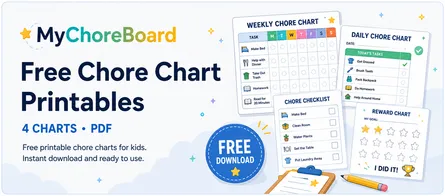
Our free printable chore chart pack gives you four starting layouts without requiring a purchased board.
DIY is especially useful if your child needs very specific picture cards that no commercial set is likely to include.
Daily routines versus weekly chore tracking
This is one of the easiest ways to choose a format.
If the routine happens in the same order every day
A Velcro picture schedule is often the strongest fit.
The child can follow the pictures through the routine without needing to understand a weekly calendar. This is especially useful for morning, after-school, and bedtime sequences.
If you want responsibilities plus visible rewards
A magnetic reward chart makes more sense.
Stars, tokens, or magnets make progress tangible and help connect completed chores with whatever reward system the parent establishes.
If you want a ready-made first chore chart
A preprinted magnetic responsibility chart requires very little design work.
It gives a younger child a recognizable, tactile system without the parent creating all of the pieces.
If the chores change and need custom wording
Use a dry-erase refrigerator board.
You give up some of the visual structure of preprinted pieces but gain the ability to write exactly what your family needs.
If you want the cheapest way to test a system
Start with a printable or DIY chart.
You can learn what actually motivates your child before spending money on a more permanent setup.
How much parent maintenance does each require?
| Format | Initial setup | Ongoing reset | Custom chores | Pieces to store | Reward tracking |
|---|---|---|---|---|---|
| Preprinted magnetic chart | Low | Medium | Limited | Medium-high | Manual |
| Magnetic reward chart | Low-medium | Medium | Moderate | High | Manual, but very visible |
| Velcro picture schedule | Medium | Low-medium for repeating routines | Good if you have/create the right cards | High | Usually secondary/manual |
| Dry-erase fridge chart | Low | Medium-high | Excellent | Very low | Manual |
| DIY printable / Velcro | Medium-high | Depends on design | Excellent | Depends on design | Manual |
| Digital | Higher initial setup | Low | Excellent | None | Automatic |
The main pattern is simple: physical systems trade automation for visibility and tactile interaction. The more custom and changeable the household schedule becomes, the more parent maintenance matters.
When a physical chore chart is the better choice
Choose physical when the interaction with the chart itself helps the child.
That might mean:
- Attaching a Velcro picture after completing a step
- Moving a magnet
- Earning a physical star
- Crossing something off with a marker
- Walking to the refrigerator and immediately seeing what is left
Physical charts also make sense when:
- The routine is fairly simple.
- The chart stays in one predictable location.
- You do not need automatic history.
- You do not need different schedules on several devices.
- You are comfortable manually resetting the system.
- Your family specifically wants a screen-free chore routine.
There is nothing inherently better about moving this kind of system into an app if the physical version is working.
When a digital chore chart becomes the better fit
Digital becomes useful when maintaining the physical chart becomes another chore for the parent.
MyChoreBoard can handle recurring schedules, multiple children, points and rewards, Bonus Tasks, Shared Task Pool chores, and a child-friendly interface. WallBoard Mode can also put multiple children on one shared tablet screen, which preserves some of the “central household chore board” feeling without asking a parent to rewrite the refrigerator every week.
The physical products above can still be excellent choices. The dividing line is usually complexity:
- Simple routine + child likes tactile interaction: physical may be better.
- Multiple changing schedules + repeated parent setup: digital usually becomes easier.
Digital can also offer a different kind of engagement. Physical charts are tactile: kids move a magnet, attach a Velcro card, add a sticker, or make a mark. A good digital chart is responsive: completing a chore can change the screen immediately, update points and reward progress, and provide animations or celebrations. Some children strongly prefer that interactive feedback; others are more motivated by something they can physically touch.
If a physical chart worked at first and then became part of the background, that does not mean the routine failed. Refresh the physical system first. If the child still stops noticing it—or if the parent is tired of rebuilding it—changing formats can give the same routine a new way to stay visible and rewarding.
Read the full guide to digital chore charts for kids or compare every format in Best Chore Charts for Kids in 2026.
Frequently asked questions
Try refreshing the physical system before replacing it: reduce the number of chores, change the rewards or stickers, move the chart, or let the child help choose new magnets or picture cards. If the routine still makes sense but the chart has become background noise, switching formats can help. A digital chart offers a different feedback loop through changing points, visual rewards, optional earning opportunities, and completion animations, while another physical format may work better for a child who prefers tactile interaction.
Many magnetic charts contain small pieces and are marketed for ages 3 and up. For very young children, follow the manufacturer’s age guidance and consider whether larger Velcro-style picture cards would be easier and safer to manage.
Neither is universally better. Velcro-style picture cards are especially useful when a child needs to follow a visual sequence and the chart is made from felt or another non-magnetic surface. Magnets work well on refrigerators and magnetic boards and are often better suited to weekly responsibility and reward charts.
Yes. Picture-based Velcro schedules can work especially well for non-readers because the child can follow illustrated routine cards instead of relying on written task names or a weekly grid.
Separate dry-erase refrigerator boards are often the easiest physical format to adapt to multiple children because each child can have their own reusable space and the parent can write completely custom chores.
A Velcro picture schedule is usually strongest for showing a sequence of steps: what happens first, next, and last. A magnetic chore chart is usually stronger for tracking responsibilities, completion, and visible rewards across a day or week.

Ready to try MyChoreBoard with your kids?
Install on any phone, tablet or computer. Free with no sign-in hoops.