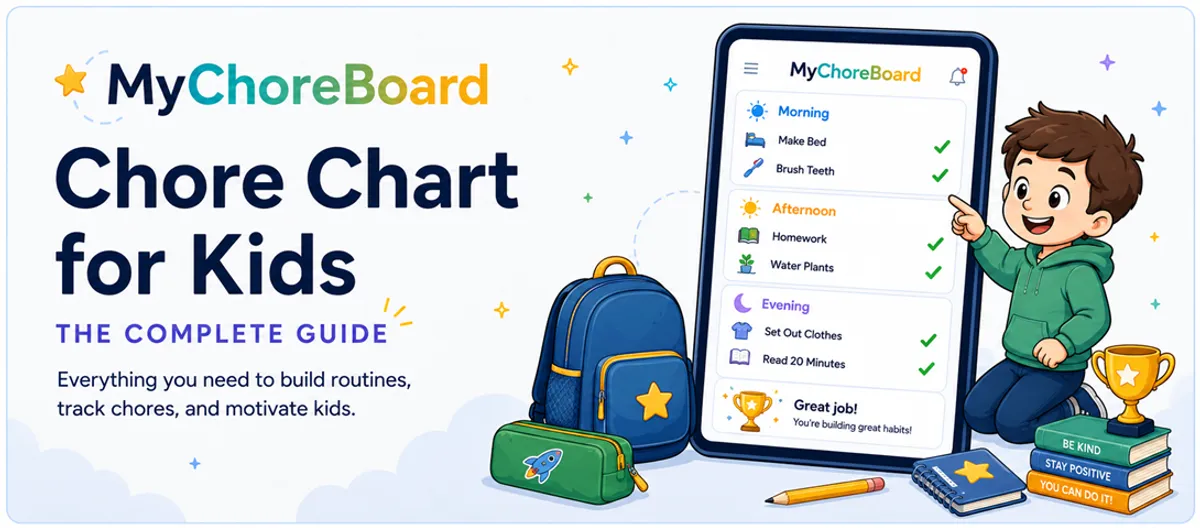
Chore Chart for Kids: The Complete Guide to Chores, Rewards, and Routines
- Jacob Volk
- Chores & Routines
- 07 Aug, 2026
A chore chart for kids is simply a visible agreement about what needs to be done, when it needs to happen, and how progress is recognized.
That can be a sheet of paper on the refrigerator, a magnetic board, a row of Velcro picture cards, a dry-erase checklist, or a digital chore chart on a phone or tablet. The format matters, but it is not the most important part.
The chore chart that works is the one your child can understand and your family can maintain.
This guide walks through the major types of chore charts, how to choose one, how many chores to start with, how rewards and allowance can fit in, and what to change when the system starts getting ignored.
Quick answer
Start smaller than you think
For most families, a few clear daily responsibilities are a better first chore chart than a perfect-looking system packed with every possible task. Build the habit first. Add complexity later.
What is a chore chart?
A chore chart is a system for making household responsibilities visible. It answers questions that otherwise turn into repeated conversations:
- What am I supposed to do?
- When do I need to do it?
- How do I show that it is finished?
- Is this a regular responsibility or an extra job?
- Do I earn points, privileges, allowance, or simply credit for helping?
For younger kids, a chart may rely on pictures and very short task names. Elementary-age kids may use a daily or weekly checklist. Tweens and teens can usually manage longer schedules, rotating jobs, and more independent responsibilities.
The strongest chore charts do not just record cleaning. They help make routines predictable.
Do chore charts actually work?
They can, but a chart is not magic.
A chore chart helps most when it replaces uncertainty with a clear next step. It gives the child a place to look instead of making the parent the only source of instructions. It also creates a shared reference point when expectations are forgotten.
Chore charts tend to break down when:
- There are too many chores at once.
- The child cannot easily understand the chart.
- The chart is kept somewhere the child rarely looks.
- Parents stop updating it.
- Rewards become stale or unreachable.
- The rules change from day to day.
- The system only appears when someone is in trouble.
A useful chart is less about control and more about reducing ambiguity.
The four main types of chore charts for kids
1. Printable chore charts
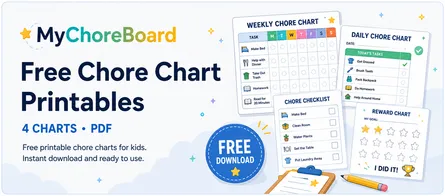
A printable chore chart is the easiest way to start. You can print one, write in a few chores, and put it somewhere visible the same day.
Best for: trying a chore system for the first time, simple routines, families that like paper, and kids who enjoy stickers or checking boxes.
Tradeoff: someone has to reprint, rewrite, or reset the chart when the routine changes.
If that sounds like the right starting point, download our free printable chore chart pack with daily, weekly, rewards, and multi-child layouts.
2. Magnetic, Velcro, and picture chore charts
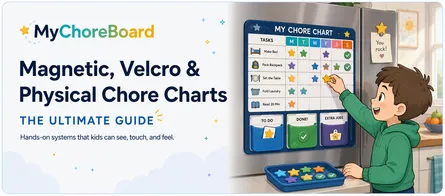
Physical reusable charts make chores tangible. Kids can move a magnet, flip a card, attach a star, or move a picture from “To Do” to “Done.”
Best for: younger kids, non-readers, visual learners, and families that want the chart to live in one central place.
Tradeoff: pieces need storage, the chart has limited space, and changing schedules can still require parent setup.
See the full guide to magnetic, Velcro, refrigerator, and dry-erase chore charts.
3. Whiteboard or refrigerator chore charts
A dry-erase board is flexible and inexpensive. It works especially well for weekly assignments, rotating jobs, and families who want to change chores without printing a new sheet.
Best for: older kids who can read, rotating schedules, and families that already use a refrigerator or family command center.
Tradeoff: it still depends on someone rewriting the board and manually keeping reward totals or history.
4. Digital chore charts
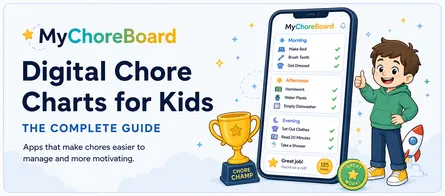
A digital chore chart stores the routine on a device. Parents can create and schedule tasks while kids use a child-facing screen to check what is assigned and track progress.
Best for: recurring schedules, multiple kids, changing routines, points and rewards, and families already using phones or tablets.
Tradeoff: the child has to remember to check the device or use a dedicated/shared display that keeps the routine visible.
Read Digital Chore Charts for Kids for a detailed comparison.
Which chore chart is best for your child?
The answer changes with age, reading ability, family size, and how complicated the schedule is.
| Family need | A strong starting choice | Why |
|---|---|---|
| Preschooler or non-reader | Picture, Velcro, or magnetic chart | The child can recognize the task without relying on text |
| Simple first chore routine | Printable chart | Fast, free, and easy to change while you learn what works |
| One central family station | Fridge or dry-erase board | Everyone sees the same board in a shared space |
| Multiple children | Multi-child printable, large whiteboard, or digital chart | Keeps assignments separated and easier to scan |
| Chores that repeat on different schedules | Digital chart | Recurring assignments reduce rewriting |
| Points and rewards | Printable reward chart or digital chart | Makes progress toward rewards visible |
| Frequent schedule changes | Digital or dry-erase | Easier to edit than a fixed printed layout |
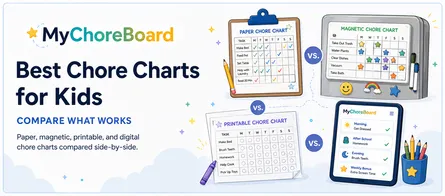
For a side-by-side roundup, see Best Chore Charts for Kids in 2026.
How many chores should a child have?
There is no universal number.
A better question is: How many responsibilities can this child complete consistently without the chart becoming overwhelming?
When starting a new system, two or three daily responsibilities can be enough. Add one weekly job if it fits naturally. Once the routine is familiar, add more.
A younger child might start with:
- Put pajamas in the hamper
- Put toys in a basket
- Carry a plate to the sink
An elementary-age child might start with:
- Make the bed
- Pack the backpack
- Clear dishes
- Feed a pet
An older child might handle:
- Unload the dishwasher
- Take out trash
- Put away laundry
- Clean a bathroom counter
- Help with a weekly household job
Choose tasks the child can actually learn to complete. A chart should create successful repetition, not a daily list of failures.
For more ideas, use our age-appropriate chores guide.
Daily routines versus household chores
It helps to separate two kinds of tasks.
Routine tasks keep the child’s own day moving: brushing teeth, getting dressed, packing a backpack, putting shoes away, or getting ready for bed.
Household chores contribute to the family: feeding a pet, clearing dishes, unloading the dishwasher, taking out recycling, wiping a counter, or putting away shared items.
Many families use both on one chart. Others keep routine steps separate from point-earning chores.
There is no requirement that every item on a chore chart earn something. Basic responsibilities can exist because everyone contributes to the household.
Should chores earn points, rewards, privileges, or allowance?
Any of these can work if the rules are clear.
Points and rewards
Points are useful when a child benefits from seeing progress. A small task might be worth a few points while a larger responsibility is worth more. Kids can then work toward privileges, activities, or items they care about.
The important part is keeping rewards reachable enough to stay meaningful. A child who has to wait months for every reward may stop caring about the system.
Privileges
Rewards do not have to cost money. Choosing dessert, picking the family movie, extra game time, choosing dinner, or staying up a little later can be motivating.
Allowance
Some families connect chores directly to allowance. Others give allowance separately and use chores to teach household contribution. A hybrid can also work: basic responsibilities are expected, while extra jobs create opportunities to earn more.
The system should be easy enough that you can explain it in one minute.
Read Using Rewards to Motivate Kids for a deeper look at positive reinforcement.
How to build a chore chart your family will keep using
Step 1: Pick one goal for the system
Maybe you want calmer mornings. Maybe you want kids to contribute after dinner. Maybe you want less repeated reminding.
Start with the problem that matters most instead of trying to organize the entire household at once.
Step 2: Choose a format your child will notice
A paper chart hidden inside a binder will not help a six-year-old remember the morning routine. A complicated app will not help if the child never opens it.
Put the system where the routine happens.
Step 3: Add a small number of clear tasks
Use specific language. “Clean room” can mean ten different things. “Clothes in hamper” and “toys in bins” are easier to understand.
Step 4: Decide what counts as done
If a task needs multiple steps, teach the steps before expecting independence. The chart can remind a child of the task, but it cannot replace showing them how to do it.
Step 5: Decide whether rewards are part of the plan
Choose the reward rules before the first disagreement. If chores earn points, assign values. If some chores are simply expected, say that too.
Step 6: Introduce it as a family tool
The framing matters. “Here is a system so you know what to do without me asking ten times” feels different from “Here is a chart because you never do your chores.”
Step 7: Review after one week
Ask what is working and what keeps getting missed. Remove chores that are too vague. Adjust rewards that are not motivating. Move the chart if nobody sees it.
Common chore-chart mistakes
Too many tasks on day one
A long list looks organized to an adult but can feel impossible to a child. Start with a few wins.
Using the same chart for very different ages
Fair does not have to mean identical. A seven-year-old and a fourteen-year-old can contribute in different ways.
Letting the chart become invisible
If the chart has been in the same spot for months, everyone may stop seeing it. Refresh the layout, move it, or change the interaction.
Making rewards the only reason to help
Rewards can support motivation, but children should also learn that some responsibilities are part of living together.
Requiring the parent to maintain too much
A chore system that creates a second job for the parent usually fades. If you are constantly rewriting, recalculating, or rebuilding the chart, simplify it or move to a more maintainable format.
What to do when the chore chart stops working
Do not assume the entire idea failed.
Try a reset:
- Cut the chore list in half for a week.
- Remove tasks the child does not understand.
- Put the chart somewhere more visible.
- Replace stale rewards or privileges.
- Ask the child which part is annoying or confusing.
- Make sure the chart reflects the current school/sports schedule.
- Decide whether the format itself is creating too much maintenance.
Sometimes a fresh printable is enough. Sometimes moving from a paper chart to a reusable board helps. Sometimes a digital chart becomes easier once the family has multiple schedules to manage.
Printable, physical, or digital: when should you switch?
Stay with a printable or physical chart if it is visible, easy to maintain, and your child responds to touching, moving, or marking the chart.
Consider digital when the problem is no longer the idea of a chore chart but the amount of parent maintenance it requires. Recurring schedules, multiple children, changing assignments, and reward tracking are all easier to automate than to rewrite.
MyChoreBoard is one digital option built specifically around chores, routines, points, and rewards. It can be used on the web, iPhone/iPad, Android, and Amazon Fire tablets, and families can also use a tablet as a shared household display with WallBoard Mode.
Frequently asked questions
Kids can start with very simple visual responsibilities in the preschool years with adult help. As reading and independence grow, the chart can become more detailed. The task difficulty matters more than a specific birthday.
Include a small number of clear responsibilities the child can realistically complete. Mix personal routine tasks and household contributions if that fits your goal. Add checkboxes, pictures, points, or reward markers only when they help the child understand progress.
Neither is automatically better. Printable charts are fast and tangible. Digital charts are easier to maintain when tasks repeat, schedules change, multiple kids need separate assignments, or points and rewards become harder to track manually.
No. Many families use a mix of expected family responsibilities and chores that earn points, allowance, or privileges. The important part is making the rule predictable rather than negotiating it after every task.
The chart may be overloaded, unclear, hard to see, too repetitive, or tied to rewards the child no longer cares about. Simplify it, make the next step obvious, and review the system with the child instead of only adding more reminders.

Ready to try MyChoreBoard with your kids?
Install on any phone, tablet or computer. Free with no sign-in hoops.